
Most people shopping for custom closet cabinets make the same mistake: they start by picking a finish. They fall in love with a white oak door style or a matte black pull, and by the time they get to the layout conversation, they've already mentally committed to something that might not actually work for their space.
We get it. The visuals are seductive. But the finish is the last decision you should make — not the first.
At Grace House Studio, we work with homeowners on cabinet projects from full kitchen overhauls to closet systems, and the clients who end up happiest are almost always the ones who came in with the right questions. This article is designed to give you those questions — and the answers — before you ever speak to a designer or request a quote.
Why Custom Closet Cabinets Are Worth the Investment
Before we get into how to buy well, it helps to understand why custom closet cabinets are worth considering in the first place — especially when big-box store systems exist at a fraction of the price.
The honest answer: it comes down to fit, function, and longevity.
Off-the-shelf systems are built around average spaces and average storage habits. Your closet isn't average. It has its own dimensions, quirks, and constraints — and your wardrobe has its own logic. A custom cabinet system is designed around both. That means no wasted corners, no awkward gaps, no shelving heights that don't actually work for what you're storing.
From a resale perspective, built-in custom closet cabinetry consistently registers as a desirable feature for homebuyers. It signals that a home has been maintained and thoughtfully upgraded. And unlike many renovation choices, a well-designed closet system tends to look timeless rather than trendy — which holds its value over time.
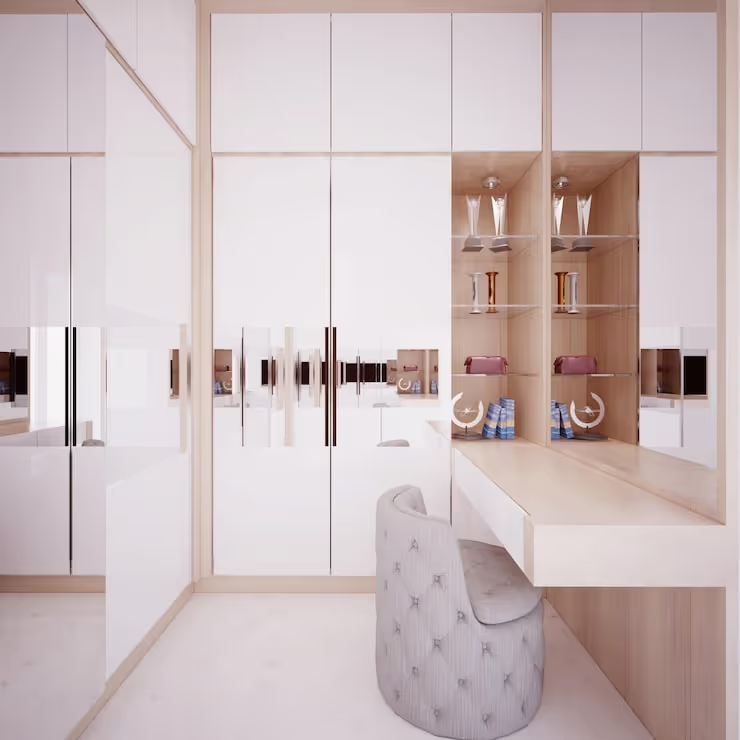
What Do Custom Closet Cabinets Actually Cost?
Cost is usually the first question buyers have, and it deserves an honest answer rather than a vague range.
Custom closet cabinet pricing varies based on three main factors: the size of the space, the cabinet construction tier, and the finish and hardware selections.
For a reach-in closet, a semi-custom or modular system typically runs between $1,500 and $4,000 installed, depending on configuration and materials. A fully custom built-in solution for the same space can range from $3,000 to $7,000 or more, depending on box construction quality, door style, and accessories.
For a walk-in closet, expect a wider range. A well-designed semi-custom walk-in might come in between $4,000 and $10,000. Fully custom walk-ins with islands, integrated lighting, specialty pull-outs, and premium finishes can run $10,000 to $20,000+ in larger spaces.
The variables that move the needle most significantly:
- Plywood vs. particleboard box construction — plywood adds cost but significantly improves durability and longevity
- Door style and finish — painted shaker doors sit at mid-range; wood veneer or specialty finishes add cost
- Drawer count — drawers are the most labor-intensive component; more drawers means higher cost
- Accessories — pull-out shoe racks, valet rods, jewelry trays, and integrated LED lighting each add to the total
The question to ask any installer isn't just "what does it cost?" — it's "what exactly am I getting for that price?" A lower quote built on particleboard boxes and basic slides will cost more in the long run than a higher quote built on plywood and soft-close hardware.
What "Custom" Actually Means — and What It Doesn't
The word "custom" is doing a lot of heavy lifting in the closet cabinet industry. It gets applied to everything from genuinely bespoke, built-in cabinetry to modular systems that have been loosely arranged to fit your space.
Here's a practical breakdown of what you're actually choosing between:
Modular/RTA systems are pre-made cabinet boxes — often flat-packed — that get configured to fit your closet. They're the most affordable option and can look sharp in the right space. But they're limited by fixed dimensions, and awkward spaces (angled ceilings, irregular walls, narrow entries) can leave you with gaps and an overall result that feels like it never quite fit.
Semi-custom cabinets are manufactured in standardized sizes but offer more finish, door style, and configuration options. A good semi-custom line gives you significant flexibility without the full cost of bespoke work.
Fully custom cabinets are built to your exact dimensions and specifications. Every inch is intentional. These are the right choice when your space is unusual, when you have very specific storage requirements, or when you want a result that looks like it was always part of the house. Our cabinet installation services cover the full range, and the right fit depends on your space and goals.
The mistake buyers make isn't necessarily choosing one tier over another. It's choosing the wrong tier for their situation — usually because a salesperson led with price rather than an honest assessment of the space.

How to Plan the Layout of Your Custom Closet Cabinets
Before finishes, before hardware — your budget is best spent on a thoughtful layout. A few questions that should drive this conversation:
What are you actually storing? Count your hanging items — long (dresses, coats) versus short (shirts, jackets, folded pants). That ratio determines how to divide hanging space. Underestimating long-hang items is one of the most common layout errors.
What's your folding versus hanging ratio? If you fold more than you hang, you need more drawers and shelving and less rod space. If you live in a hanging-heavy wardrobe — suits, dresses, blouses — you need generous rod runs with coordinating drawer towers.
Where do shoes go? Angled shoe shelves are compact and visually satisfying. Flat shelves with lip guards work for larger sizes. Cubbies are easier to keep organized. Pull-out shoe racks offer the fullest visibility. The right choice depends on how many shoes you have and how much floor versus wall space you're working with.
Do you need a folding or staging surface? In a large enough walk-in, a center island with a flat top is one of the most useful additions you can make. It gives you a place to lay out tomorrow's outfit, fold laundry, and store out-of-season items in deep drawers below.
Why Custom Closet Cabinet Construction Quality Matters More Than You Think
Once layout is settled, construction quality determines how your cabinets hold up five and ten years from now.
Box construction matters more than it looks. Plywood-core cabinet boxes hold screws better, resist warping in fluctuating humidity, and simply last longer than particleboard alternatives. This is especially relevant in closets, which experience more temperature and humidity variation than kitchens. If a quote doesn't specify the box material, ask.
Drawer boxes and slides are where you feel quality every day. Soft-close undermount drawer slides are now the baseline expectation in well-made cabinetry. Dovetail joinery on drawer boxes signals quality construction. If drawers feel flimsy in a showroom, they'll feel worse in two years.
Door style affects more than aesthetics. This is where the framed versus frameless cabinet distinction matters. Frameless (European-style) doors offer more interior access and a cleaner, contemporary look. Traditional framed construction suits classic or transitional interiors. Neither is categorically better — it depends on your aesthetic and how the closet will be used.
Choosing Finishes and Hardware for Custom Closet Cabinets
Once layout and construction are settled, finish selection becomes genuinely enjoyable.
On finishes: Painted cabinets in white, warm white, and soft greige remain consistently popular because they brighten a closet interior and don't date quickly. White oak cabinets have had a sustained run as one of the most desirable wood tones in residential design — and they look as good in a closet as they do in a kitchen. Walnut reads as rich and dramatic for a moodier, more intentional feel.
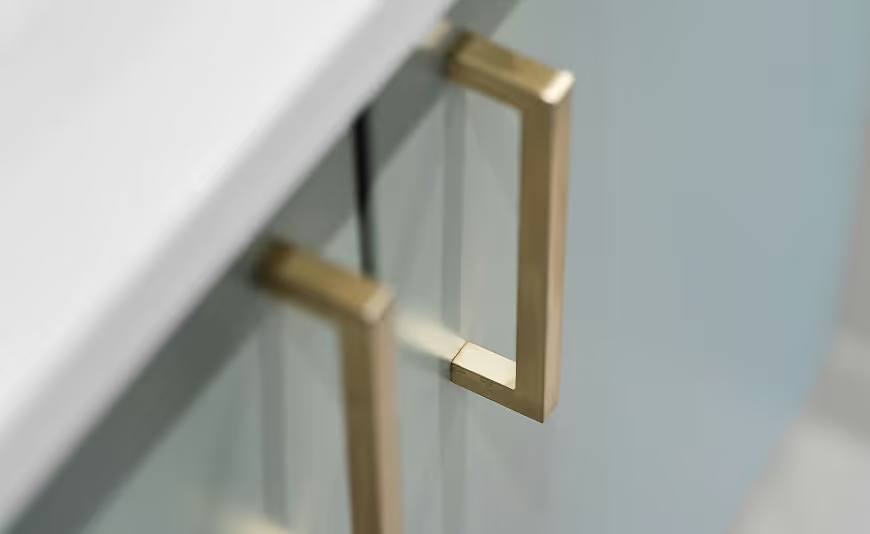
On hardware: Pull style and finish should feel cohesive with your bedroom and bathroom. Brushed gold pairs beautifully with white oak or painted whites. Matte black is graphic and strong — best in modern or industrial-leaning interiors. Satin nickel sits neutrally and pairs with almost anything. Explore options through Grace House Studio's hardware collection.
On lighting: Built-in LED strip lighting inside cabinet interiors is one of the highest-return additions you can make to a closet. It's relatively inexpensive to add during installation and makes an enormous difference in how the finished space feels and functions every single day.

The Question Nobody Asks About Custom Closet Cabinets (But Should)
"What happens after installation if something isn't right?"
Custom cabinetry is an investment, and installation day doesn't always go perfectly. A drawer might need adjustment. A door might need a slight realignment. Ask about post-installation support before you sign anything. A company that stands behind its work will have a clear, honest answer. One that hesitates or redirects is telling you something.
Working With Grace House Studio
Grace House Studio serves homeowners across Northern Virginia — including Arlington, Fairfax, Woodbridge, Manassas, Burke, and surrounding communities — with cabinet installation, countertops, kitchen remodeling, bathroom remodeling, and flooring. Whether your project is a full closet system or a whole-home refresh, we approach every project with the same design-led thinking.
Browse our cabinet materials, explore our services, or contact us to request a free quote. We also offer a design consultation for clients who want expert guidance before making any decisions.
The best custom closet cabinets aren't the most expensive ones — they're the ones designed honestly for the way you actually live.
%20%40dnicoledesignstudio.webp)