The internet makes countertop installation look deceptively manageable. There are tutorials that walk you through every step, forums full of enthusiastic DIYers sharing their results, and the undeniable appeal of saving money on a project that already feels expensive. We understand the impulse completely.
But after years of fabricating and installing countertops for homeowners across Alexandria, Arlington, Fairfax, and beyond, we've seen what the tutorials don't show you — the cracked slabs, the uneven seams, the cabinets that can't bear the load, and the phone calls from homeowners trying to salvage a project that's gone sideways. This post isn't designed to scare you. It's designed to give you the full picture so you can make a genuinely informed decision about one of the most significant investments in your kitchen or bathroom.
The Upfront Savings Are Real — But Incomplete
Let's be clear: the labour cost savings of going DIY are real. Professional countertop installation — including templating, fabrication, and fitting — typically adds several hundred to a few thousand dollars to a project depending on size and complexity. That's meaningful money, and it's understandable that homeowners want to hold onto it.
But the true cost comparison isn't "DIY labour cost vs. professional labour cost." It's the total cost of each outcome — including everything that can go wrong, the tools you'll need to buy or rent, and the value of your own time. Once you factor all of that in honestly, the calculation often looks very different.
Hidden Cost #1: The Tools You Don't Already Own
Cutting, shaping, and installing stone countertops — whether granite, quartz, or marble — requires specialised equipment that most homeowners simply don't own and won't use again.
A quality diamond blade wet saw suitable for cutting stone runs $300–$800+. Suction cup lifters capable of handling a 200+ lb stone slab cost $150–$400 for a set adequate for the job. A polishing kit for finishing edges properly can add another $100–$200. And that's before you factor in clamps, adhesives, and any structural reinforcement materials your cabinets might need.
When rental is available, the cost is lower — but the learning curve is the same. These are precision tools that professionals use daily. Getting clean, accurate results on your first attempt, on a slab that cost $1,500–$4,000, is genuinely difficult.
What pros bring: At Grace House Studio, our fabrication and installation team works with industrial-grade equipment every single day. The templating is precise, the cuts are clean, and the result is a fit that looks intentional rather than improvised.
Hidden Cost #2: Templating Errors Are Brutal
This is arguably the most underappreciated risk in DIY countertop installation. Before a single cut is made, the countertop space needs to be templated — measured precisely to account for every corner, angle, cutout, and wall irregularity. In most homes, including the majority of properties we work in across Northern Virginia, walls are not perfectly square and corners are not perfectly 90 degrees.
A templating error of even a few millimetres can mean a slab that doesn't fit properly, gaps along the wall, or a cutout that's in the wrong position for your sink or cooktop. With stone, there's no forgiving adjustment. You can't shave a little off and hope for the best. A slab that's been cut incorrectly is, in most cases, a slab that needs to be replaced.
At the countertop fabrication and installation level we work at, templating is a precision process — done with digital tools that capture every idiosyncrasy of your kitchen so the slab is fabricated to fit your actual space, not an approximated average.
Hidden Cost #3: Stone Slabs Are Unforgiving (and Heavy)
Natural stone is not a forgiving material. Quartz, granite, and marble slabs are rigid, brittle, and extraordinarily heavy — a standard kitchen slab can weigh anywhere from 150 to 400 lbs depending on size and thickness. Moving and positioning slabs of this weight without the right equipment and the right number of hands is genuinely dangerous — both to the stone and to the people handling it.
Cracks typically occur at the thinnest points of a slab — around sink cutouts, near corners, or along seams. These are precisely the moments of greatest stress during DIY handling. A crack that appears during installation doesn't always look dramatic at first, but stone cracks propagate. What starts as a hairline fracture near a cutout can expand over weeks or months into a full structural failure.
Once cracked, granite, quartz, or marble cannot be invisibly repaired. The slab either needs to be replaced entirely or you live with a visible repair. Either way, the cost far exceeds any labour savings you captured upfront.
Hidden Cost #4: Your Cabinets May Not Be Ready
Stone countertops are heavy. Standard kitchen base cabinets are designed to bear the weight of a countertop — but only when the base is level, the structure is sound, and the load is evenly distributed. In many older NoVA homes, cabinets have settled, shifted, or simply aren't as structurally sound as they appear.
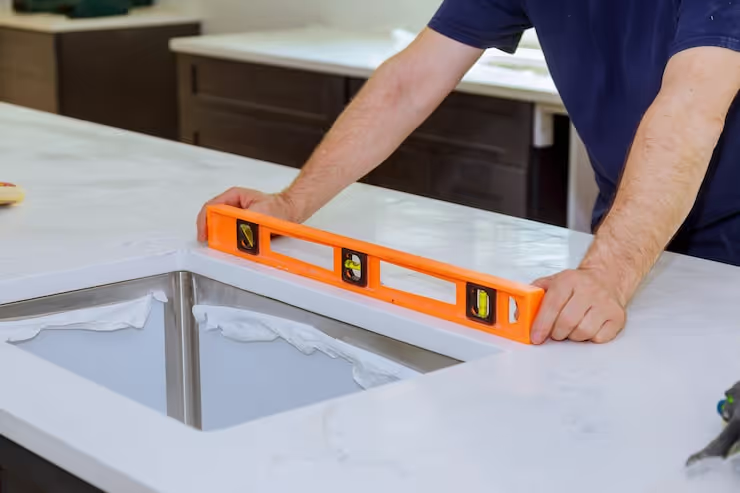
Before any countertop installation, the cabinet bases need to be checked for level across their entire run. Even a small deviation — a quarter of an inch across a 10-foot run — can create enough stress in a stone slab to cause cracking over time, or simply result in visible gaps and an uneven finished surface.
Professional installers identify and address these issues before the stone goes down. DIYers often discover them after the fact, at which point the slab is already in place and the fixes are far more complicated and expensive.
Hidden Cost #5: Sink and Cooktop Cutouts Require Precision
If your countertop requires cutouts — for an undermount sink, a cooktop, or a faucet — those cuts need to be perfectly sized, positioned, and finished. An undermount sink cutout that's slightly too large leaves a gap at the rim that can allow water to penetrate the stone edge and damage the cabinets below over time. A cutout that's too small means the sink doesn't fit.
The interior corners of cutouts are also stress concentration points where cracking is most likely to occur if the cut isn't made with the right blade speed, water cooling, and technique. Professional fabricators make these cuts on a wet saw with a diamond blade specifically suited to the stone type and thickness.
One of the reasons Grace House Studio's countertop service includes free sink cutout and undermount sink installation as standard is precisely because we know how critical this step is — and how much can go wrong when it's done without the right equipment.
Hidden Cost #6: Sealing — Done Wrong, It's No Protection at All
Natural stone countertops — particularly granite and marble — need to be sealed after installation to protect against staining and moisture penetration. Done correctly, sealing is straightforward. Done incorrectly, it provides false assurance.
Common DIY sealing mistakes include applying sealer to stone that hasn't been fully cleaned and dried, applying too much sealer (which can leave a hazy residue), using the wrong sealer formulation for the stone type, or simply skipping sealer reapplication on the schedule the stone requires.
A poorly sealed marble countertop is vulnerable to etching and staining from everyday kitchen use — lemon juice, red wine, tomato sauce. Once staining penetrates unsealed marble, professional restoration is the only option. Our countertop installation service includes a professional sealer application as standard, using the correct product for each specific stone type.
Hidden Cost #7: Time — Yours Is Worth More Than You Think
Here's the cost that homeowners most consistently undervalue: their own time. A professional countertop installation team — with the equipment, experience, and people to do the job properly — can typically complete a standard kitchen countertop installation in a single day. Templating happens first, fabrication in our shop, then installation.
A DIY project, particularly for a first-timer, rarely moves that efficiently. Research, tool acquisition, templating, dry-fitting, adjustments, actual installation, finishing — realistically, you're looking at multiple weekends of work, minimum. And throughout that period, your kitchen is out of commission.
For most Northern Virginia homeowners — professionals with demanding schedules, families with young children, people who simply value their weekends — the time cost alone makes the professional option worth it.
What Professional Countertop Installation Actually Includes
When homeowners see a professional installation quote and compare it to the apparent DIY saving, they're often not comparing equivalent things. At Grace House Studio, our countertop fabrication and installation service starting at $45 per square foot installed includes:
- Free in-home estimate and templating
- Custom in-house fabrication to your exact measurements
- Professional delivery and installation
- Free removal and haul away of your existing countertops
- Free sealer application
- Free standard edge profile (eased, quarter bevel, half bevel, half bullnose)
- Free undermount single bowl sink and cutout installation
- Free single faucet hole
When you lay that against the real cost of a DIY attempt — tools, time, risk of error, and the potential cost of a cracked or poorly fitted slab — the professional route often represents better value, not just better results.
When DIY Countertops Can Work
In the spirit of honest advice: there are situations where DIY countertop installation is more viable. If you're working with butcher block rather than stone, the material is more forgiving, lighter, and easier to cut with standard woodworking tools. Tile countertops, while less popular today, are also more accessible for a skilled DIYer. And if you have genuine experience with fabrication tools and stone handling, the calculus changes.
But for granite, quartz, or marble — the materials that make up the majority of what Northern Virginia homeowners want in their kitchens — the precision and physical demands of the job make professional installation the genuinely smart financial decision in most cases, not just the convenient one.
The Bottom Line
DIY countertop installation isn't impossible. But the hidden costs — tools, time, the risk of a cracked slab, templating errors, improper sealing, and cabinet issues discovered too late — have a way of adding up to more than the labour saving you started with. And unlike many home projects where a mistake is annoying but fixable, a cracked stone slab or a poorly fitted countertop is an expensive, irreversible problem.
If you're planning a kitchen remodel or bathroom renovation in Northern Virginia and want to explore your countertop options with a team that's done this hundreds of times, contact Grace House Studio for a free in-home estimate. We'll measure your space, walk you through the materials in our showroom or bring samples directly to your door, and give you a clear, complete picture of what professional fabrication and installation looks like — with no hidden costs on our end either.

%20%40dnicoledesignstudio.webp)